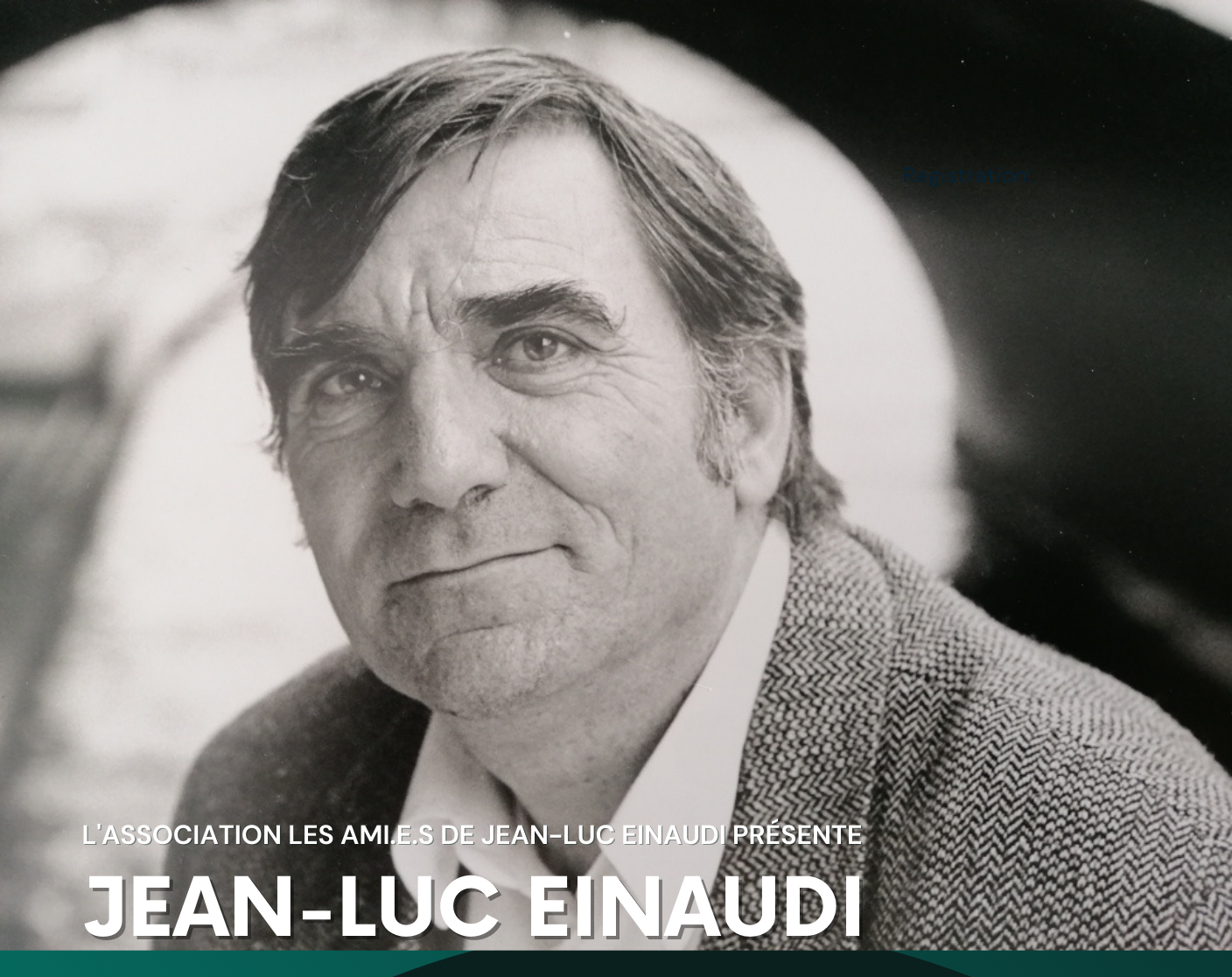

Archives de Jean-Luc Einaudi
1999 - France Culture Panorama - Interview with J.-L. Einaudi / The Papon Trial / October 17, 1961
1999 - France Culture Panorama - Interview with J.-L. Einaudi / The Papon Trial / October 17, 1961
France Culture – Panorama. Date: May 1, 1999
Contents: Interview with J.-L. Einaudi / The Papon trial / October 17, 1961 / The reasons for his interest in these events / His working and research methods
The research and testimonies of Jean-Luc Einaudi, historian and researcher, concerning the events of October 17, 1961 in Paris. He draws on his book The Battle of Paris October 17, 1961 (1991), his legal action against Maurice Papon, and direct testimonies from the time.
The Context of the Event (October 1961)
The massacre was part of the final phase of the Algerian War, which had lasted for seven years. The atmosphere in mainland France was marked by extreme tension and a crisis at the highest levels of government.
- Negotiations on hold: Peace talks had broken down in July 1961 due to disagreements over the future of the Sahara and its oil resources.
- Political crisis: A deep divergence existed between Charles de Gaulle, who wanted to end the war, and his Prime Minister Michel Debré, who favored a hard line.
- OAS terrorism: The Secret Armed Organization carried out numerous attacks. In September 1961, an assassination attempt targeted De Gaulle.
- Violence against the police: Between the end of August and the beginning of October 1961, 11 police officers were killed in Paris and the suburbs by armed groups of the FLN, exacerbating a desire for revenge within the police force.
The Special Regime for Algerians
Under the authority of Police Prefect Maurice Papon, a climate of collective repression had taken hold. Although officially "Muslim French citizens of Algeria," Algerians lived under a regime of police terror. A few days before the massacre, a discriminatory curfew was imposed, prohibiting Algerians from going out after 8 p.m. or from being in groups of more than two during the day.
The Course of the Massacre of October 17th
The demonstration of October 17, 1961, was organized by the FLN to peacefully protest against the curfew. Jean-Luc Einaudi points out that there were no clashes between two sides, but a veritable "manhunt".
Deadly and Systematic Violence
- Racial nature: The police forces targeted individuals based on their physical appearance ("racially discriminatory typology"). Italians and Spaniards were also rounded up by mistake.
- Lack of resistance: The protesters were unarmed and offered no resistance. No police officers were wounded by gunfire that day.
-
Places of repression:
- The Grands Boulevards: Near the Le Rex cinema, police opened fire on a peaceful procession.
- Neuilly Bridge: Shots were fired at protesters coming from the shantytowns of Nanterre.
- The Seine: Many Algerians were thrown into the river, sometimes from the top of the bridges of Paris.
- Police Prefecture: Witnesses report a massacre of around fifty people in the courtyard of the prefecture itself.
Places of Internment
More than 10,000 people were arrested. Papon requisitioned RATP buses to transport prisoners to centers such as the Palais des Sports or the Parc des Expositions.
|
Place |
Description of the Violence |
|
Sports Palace |
The practice of "welcoming committees": prisoners passed between two lines of police officers who systematically beat them on the head or genitals. |
|
Police Headquarters |
Summary executions reported by Republican police sources. |
|
Internment centers |
Torture and violence against defenseless wounded people. |
Testimonies and Evidence of the Atrocity
The testimony of Gérard Grange , at the time a seminarian and student nurse requisitioned to the Palais des Sports, confirms the horror of the events:
- He describes police officers (in uniform and in plain clothes) beating prisoners with wooden planks.
- He personally saw nine lifeless bodies piled up in a warehouse.
- He reports gunfire in makeshift toilets and the screams of tortured people.
Despite the seriousness of these events, the religious and military authorities of the time, alerted by Grange and his comrades, downplayed them, claiming that "if it were true, we would have known".
The Assessment: Between Official Figures and Historical Reality
The cover-up of the massacre was immediate and deliberate, both by the police prefecture and by the political authorities.
- Official toll at the time: 3 dead.
- Jean-Luc Einaudi's estimates: He puts the number of victims at more than 200, or even 300 dead and missing.
- Additional information: A massive increase in the number of drownings was noted by the Attorney General of the Paris Court of Appeal. At the Forensic Institute, more than 100 bodies were reportedly received in a short period, some of which were thrown back into the Seine due to lack of space.
The Battle for Memory and Judicial Truth
For decades, the event was suppressed. It was only through the work of researchers like Einaudi and the context of the Bordeaux trial against Maurice Papon (for complicity in crimes against humanity under Vichy) that the truth resurfaced.
The Defamation Trial (1999)
In 1998, Maurice Papon sued Jean-Luc Einaudi for defamation following an article in Le Monde . This trial became a platform for the truth.
- Recognition of the massacre: For the first time, the deputy prosecutor described the events of October 17, 1961 as a "massacre".
- Historian acquitted: Einaudi was acquitted on the grounds of good faith. The 30-page judgment took into account the extensive testimonies and documents.
- Papon's failure: Papon hoped that a conviction of Einaudi would discredit the testimony that the latter had given in Bordeaux.
The Obstacle of the Archives
Despite progress, access to archives remains a point of contention. Jean-Luc Einaudi denounces the persistent refusal to allow him to consult the archives of the Paris Police Prefecture and the Paris Public Prosecutor's Office. He also contests the methodology of the Mandelkern report (commissioned by the Ministry of the Interior), which tends to downplay the record by relying on a partial reading of official documents.
Key Quotes
"There was a massacre in Paris that day, a massacre perpetrated by police forces acting under the orders of Maurice Papon." — Jean-Luc Einaudi
“We were in a democratic system [...] and within that system, there was a segment of the population [...] living under a system that was not at all democratic.” — Jean-Luc Einaudi
"I saw nine bodies on the ground, dead... I also witnessed Algerians being machine-gunned in the makeshift toilets." — Gérard Grange
"Do we recognize, or do we not recognize, that every human life is worth as much as every other life, and that every life has equal value to every other life, or not?" — Jean-Luc Einaudi